
Most tree trouble on a building site starts on paper. The pool goes where it looks best on the plan, the extension runs to the boundary, the driveway takes the straightest line, and nobody measures the gum tree in the corner until the council’s tree officer does. By then the design is drawn, the builder is booked and the fix is expensive.
The tree’s canopy is the wrong thing to look at. What councils care about is the root zone, and it is usually far bigger than people expect.
How big a tree’s root zone is
Under the Australian Standard for protecting trees on development sites, AS 4970, a tree’s root zone is a circle around the trunk with a radius of 12 times the trunk diameter, measured 1.4 m above the ground, never less than 2 m or more than 15 m. A trunk 45 cm across has a root zone 5.4 m out from the trunk in every direction: about 91 m², more than a lot of backyards.
Inside it is a smaller circle, the structural root zone, where the thick woody roots that hold the tree up sit. Digging, trenching or footings there can make a tree unstable, and councils rarely accept it.
The 2025 edition of the standard calls the outer circle the notional root zone (NRZ) and keeps “tree protection zone” for the fenced area protected on site, but the calculation is the one councils, architects and builders have used for years.
How councils judge it
Councils look at how much of that circle your works take, the encroachment, as a percentage:
- Small encroachments (up to about 10%) are usually manageable with protection fencing and ground protection.
- Larger ones need an arborist to show the tree will stay healthy. Published summaries of AS 4970-2025 describe moderate encroachments of up to 20%, and major ones of 20 to 30% backed by root mapping and a tree-sensitive design.
- Anything in the structural root zone, or well past 30%, usually means a redesign or an application to remove the tree.
Every council also has its own rules on which trees are protected in the first place. Our council tree rules pages set them out for all 32 Sydney councils.
Not sure how your plans measure up? See it on an aerial photo of your own property in a couple of minutes.
Check it yourself in a couple of minutes
We built a free tree protection zone calculator so you can see this before you commit to a design. It takes three steps:
- Find your property. Type the address and pick it from the list; an aerial photo of the block opens.
- Draw what you’re building. Choose pool, extension, driveway, shed and so on, and tap its corners on the photo.
- Place your trees. Tap the centre of each tree and enter its trunk size. A tape measure around the trunk at chest height is all you need; the calculator converts it.
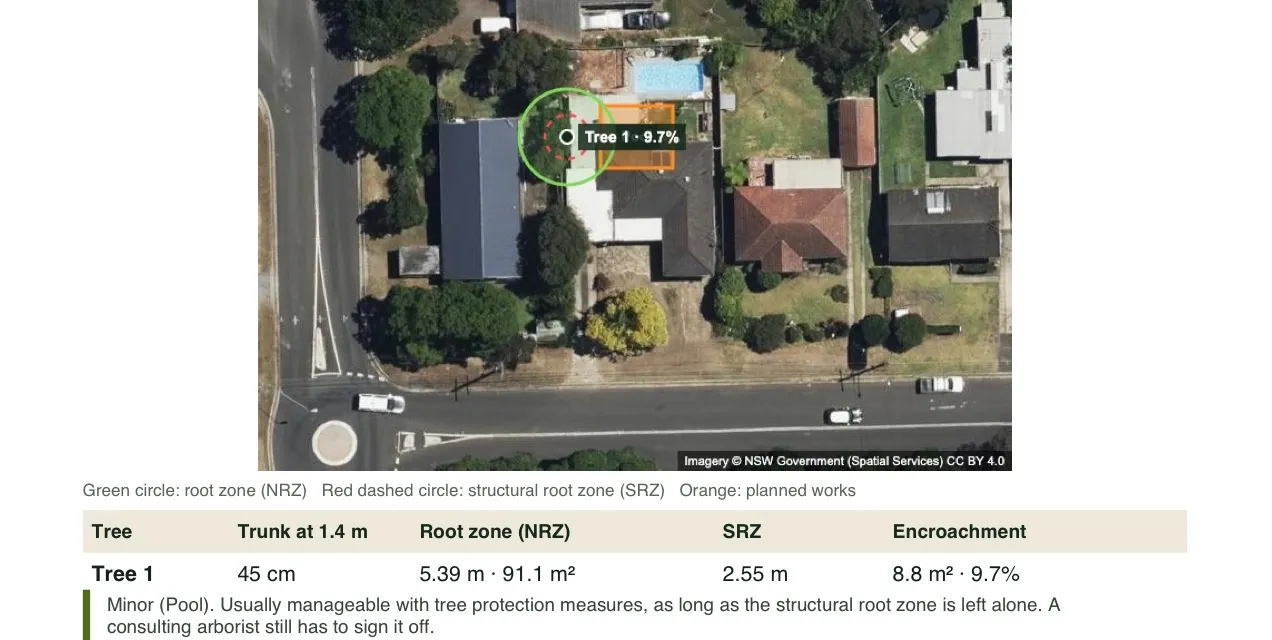
It draws each tree’s root zone and structural root zone to scale, works out how many square metres and what percentage your plans take, and tells you what that usually means. This is the report it produced for a pool planned near a 45 cm tree on a Sutherland Shire block:
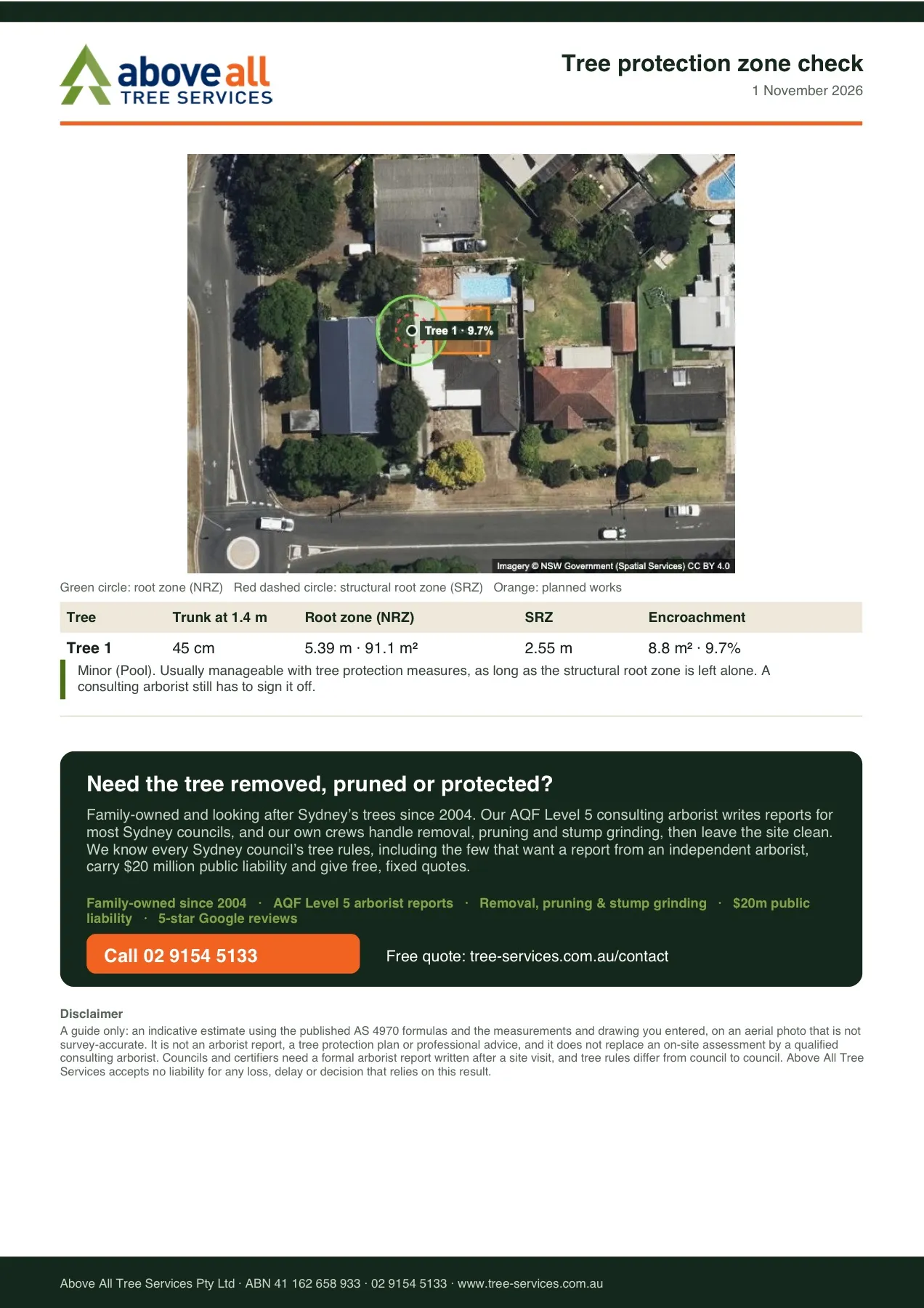
The pool clips 9.7% of the root zone and stays out of the structural root zone: a minor encroachment, usually manageable with protection measures. Shift the pool a metre closer and it would cut into the structural roots, which is the kind of change that is free on paper and expensive after a refusal.
Keep it, share it, or send it to us
When you have a result you can:
- Download a PDF to show your architect, builder or certifier. It is made on your own device.
- Email it to yourself, from our office mailbox.
- Ask for a quote. The address, the map with your trees and plans and the results come with it, so you only add your name, number and what you’re planning.
Getting it right before you lodge
If the calculator shows an encroachment, talk to an arborist while the design can still move. Shifting a pool, switching to pier footings or bridging a driveway over the roots costs little at the drawing stage.
Our consulting arborist, Josh Baber (AQF Level 5), measures every tree properly and writes the report your council or certifier asks for, with the protection measures for the build; see what goes in an arborist report. A few councils, including Woollahra and Lane Cove, only accept reports from an arborist with no link to tree work. If yours is one of them we’ll tell you up front, and we can still quote the approved removal or pruning.
Check your plans now, free, on an aerial photo of your property. Or call us on 02 9154 5133.